
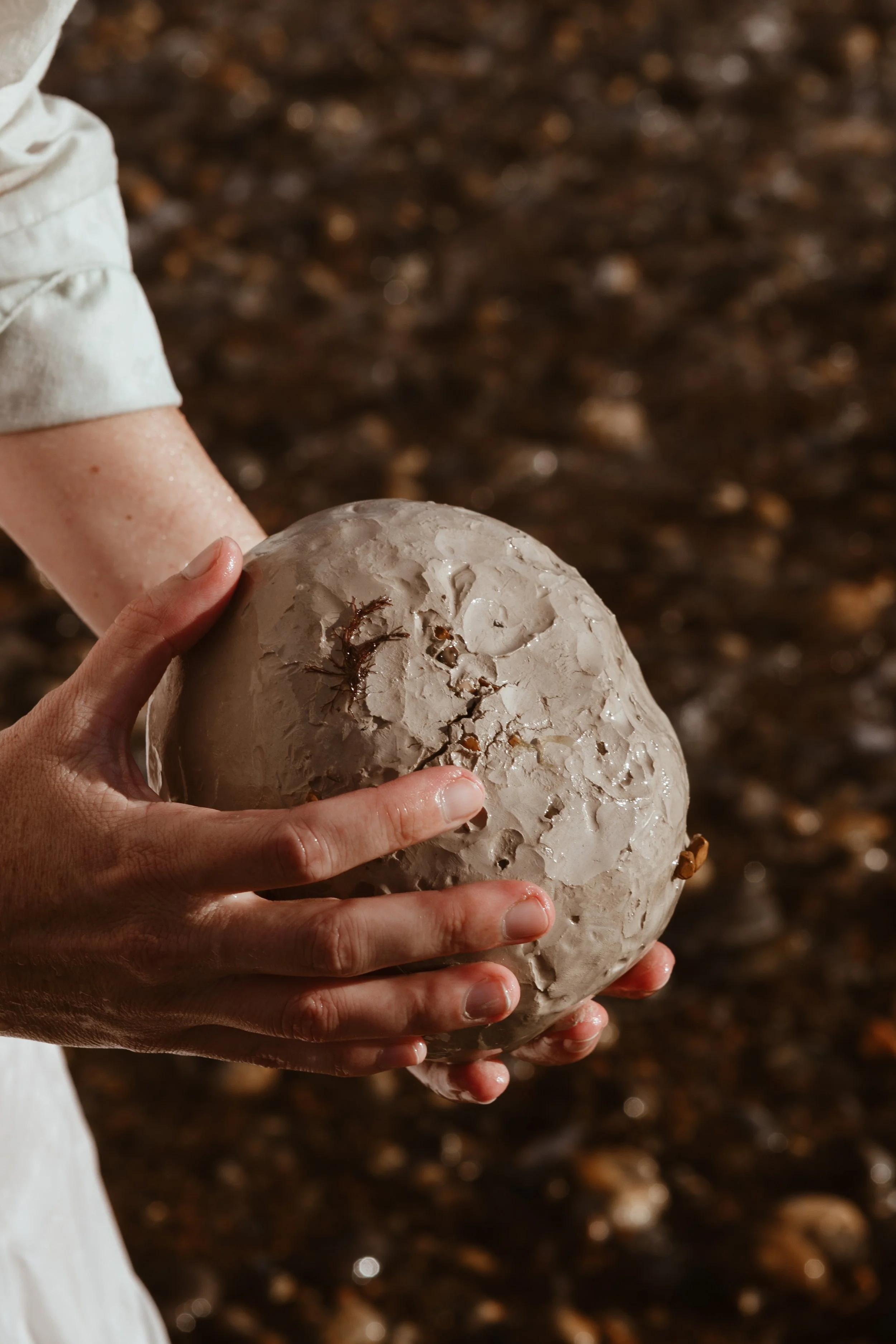
The vessel and the artist undergo the same event.
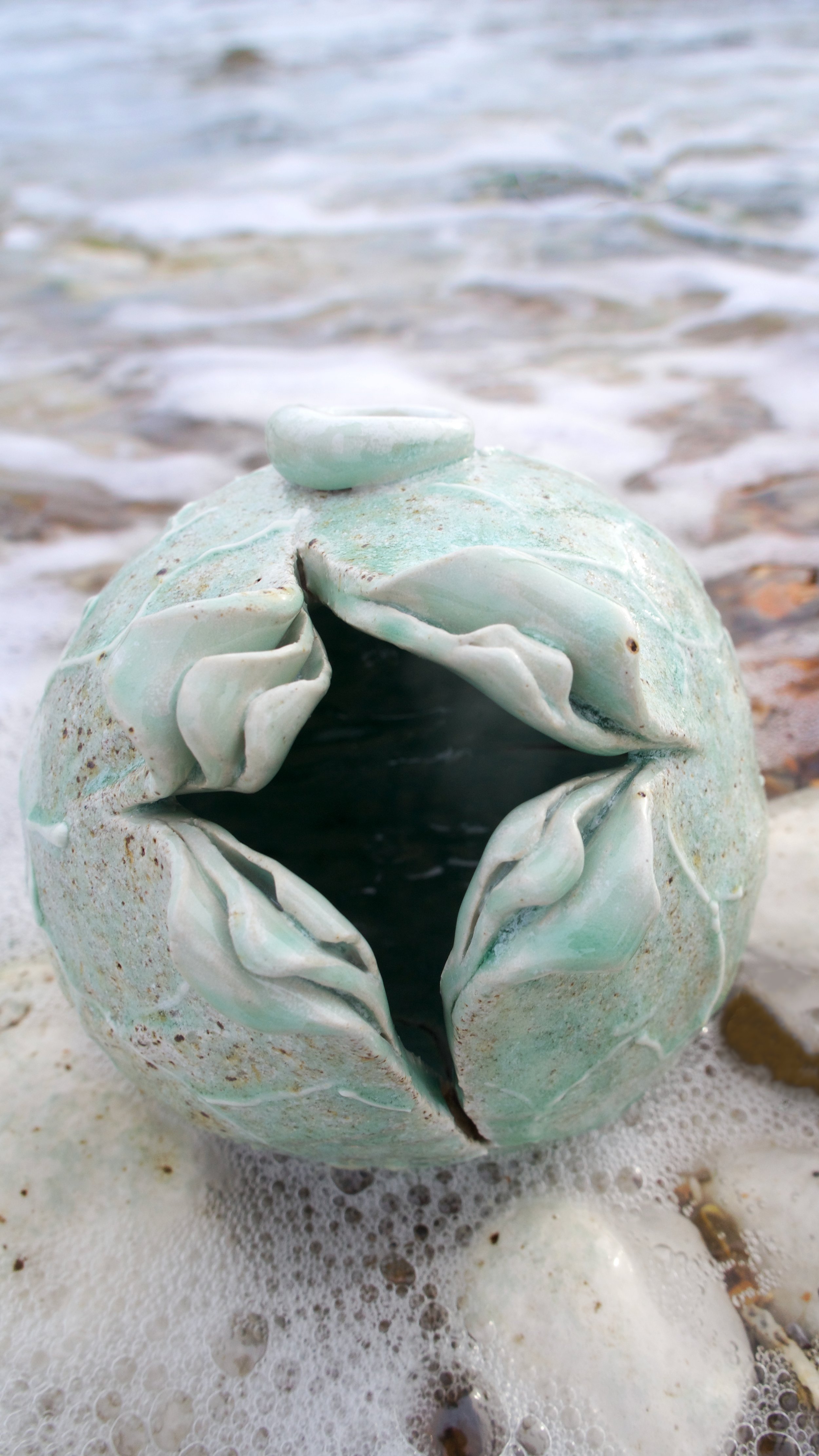
Ocean Break No.1.
The marks here aren't mine by hand. The crack: ocean, a third wave, the biggest of the set. The crease where I sat on my suitcase to force it shut. Biography written without intention. It is still teaching me something.When I bring a hand-formed clay vessel into the field — to the shoreline, the woodland, the stream — it is not a recording device. It is a companion body. The wave that strikes my legs strikes the clay. What the work holds is not my interpretation of an encounter but the material record of one we shared. I call this Autobiographical Objecthood: the vessel develops a parallel biography to the artist through co-presence, not representation.
The unpote — from un pote, a companion, and from the biological state of potentiation, of becoming — enters each encounter unformed and uncommitted, shaped by what acts upon it. As I am. The object is not a symbol of experience. It is a co-witness to it.
This framework runs through the full lifespan of each piece. Firing is not an endpoint but a phase shift — the vessel continues to develop through the environments it enters, through breakage, through repair, through the hands that hold it long after it leaves mine. A piece I consider finished is better understood as mid-act. If it breaks in your home, it comes back to me. We continue its life together.
Current work under this framework includes vessels formed across tidal cycles on the Sussex coast, figurines shaped through the postnatal body and marked by intergenerational touch, and a land and garden unpote currently in development at a storied Arts & Crafts estate in Sussex, exploring what a cultivated landscape leaves behind in clay. Each project asks the same question from a different place: what does it mean for an object to have lived?
The unpote is an avatar of experience. Two stories, briefly aligned.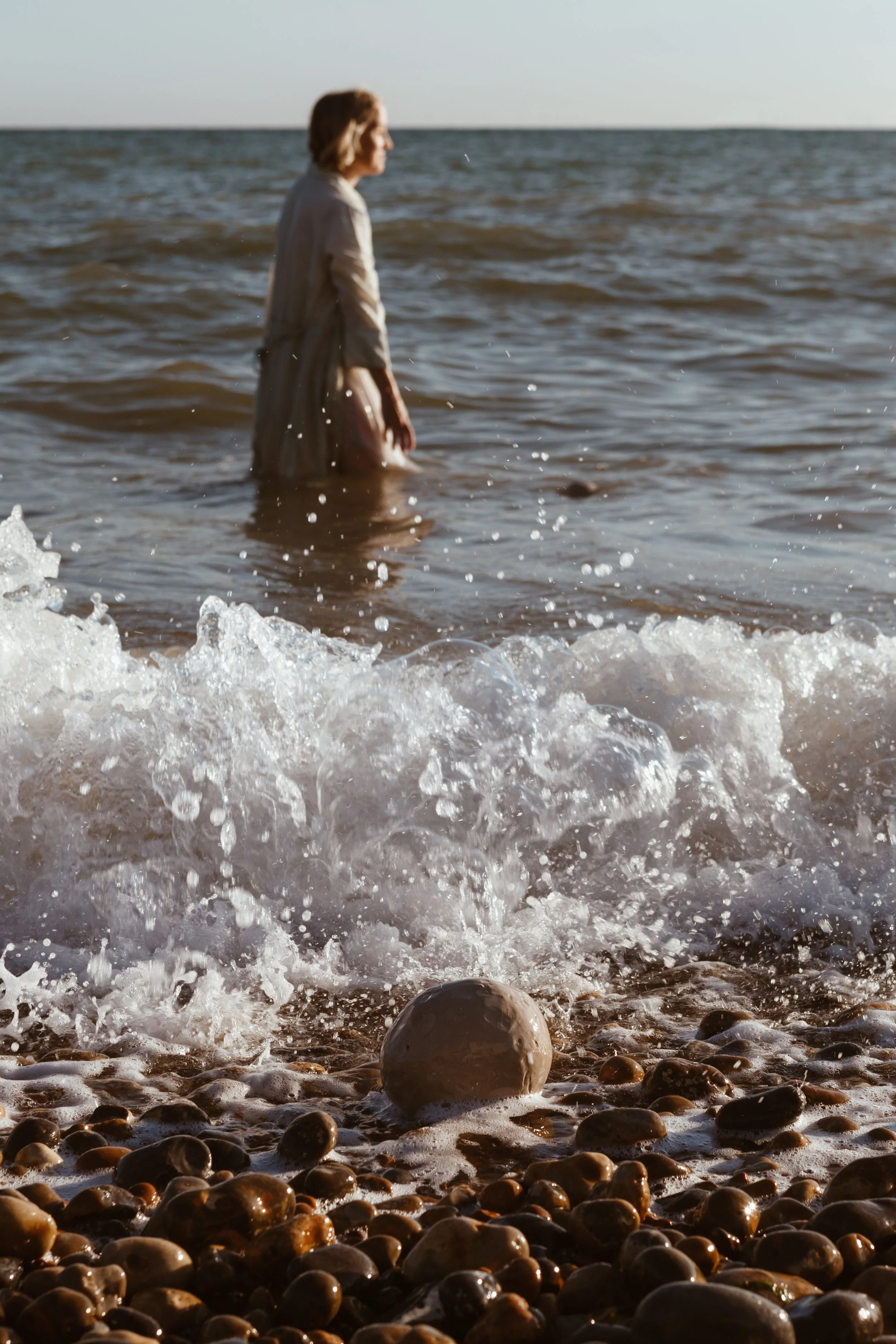
The Co-Witness: Autobiographical Objecthood
and What Clay Can Be
Laurie Jeanne
Working paper, 2026
I.
The idea came to me whole. Not as a theory, not as a reading, not as a technique I had seen elsewhere. It arrived as a vision. I am in the water, tumbling, completely consumed; water moving through me, around me, insisting on its own logic regardless of what I intend. And then, in my place, there is a clay ball. Doing the same. Receiving the same forces. Going where I go. It felt it, and materialised it. That vision gave me two things simultaneously: the form as a hollow clay sphere, structurally responsive to pressure, shaped by its environment. And the proposition that this object could experience the world the way I do, and carry the proof of it.
I had spent time learning the physical properties of clay: the particle alignment, how water interacts with the macro-molecular structure, what pressure does to a forming body. I understood this not from formal training but from research, podcasts, the usual night classes for throwing, and from the hands themselves, which know things the mind arrives at later. What I also brought was a background in cancer biology. My postdoctoral work at the Francis Crick Institute, under Dr Ilaria Malanchi, had trained me to read living systems through the balance of intrinsic and extrinsic shaping: how a cell becomes what it is through continuous negotiation between what it carries internally and what its environment demands of it. When I looked at the clay ball tumbling in the water, I recognised that logic. I did not borrow it consciously. I saw it, already there, in the clay.
I call the practice Autobiographical Objecthood. The vessel and the artist undergo the same event. Clay is not a surface onto which experience is expressed; it is a companion body, present in the same moment, subject to the same forces, changed by what changes me. It is taking its space in this world.
II.
The argument begins in physics, not in poetics.
Clay particles are bound with water even in their firmer states. Under pressure, this water helps align them into a coherent body; in more dilute conditions, they drift and align at random. I shape with water because water is part of their essence, and all life’s essence: a play on the limit between shape and non-shape. The hollow sphere exploits this precisely. The trapped air provides responsive resistance, pushing back against external force; the clay wall transmits and records that negotiation. A wave lifts the unpote and applies a sliding shear force along the edge that realigns clay particles along the wall. This is an invisible reshaping that emerges during drying and firing, legible as a subtlety of surface that no other material could hold. When the sphere is compressed against sea pebbles the particles align further. Occasionally the pressure exceeds what the wall can negotiate and impact cracks appear: small escapes of trapped air. The sphere is not passive. It is, in the most literal sense, pushing back.
I call these companion vessels unpotes: from un pote, a companion, and from the biological concept of potentiation: uncommitted, open to becoming. The name came after the making. The form, that ancient, simple pinch-pot-closed-into-sphere is one of the oldest techniques in ceramics. It was already doing the work before I had language for it. The practice preceded the theory. The vision came first. Whereas the biology I recognised retrospectively. But this is not a framework applied to clay from the outside; it is what clay, handled this way, in these conditions, was already enacting.
In situ ceramics, as I use the term, means that the clay form is shaped by the environment, not merely that the artist is standing in a landscape while working. The environment can be tidal, ecological, architectural, or entirely domestic. One of my earliest unpotes was rolled across a living room floor, accumulating Lego impressions and the unpredictable gestures of small hands. It received what acted on it. The principle is the same at the shoreline: the unpote goes into the water and the water acts on it. What I add deliberately (placeborne finishes, gathered minerals, chalk slip, or the artist’s own intentional gesture) is identified as such and kept distinct from what the environment gives. The marks left without my hand, what I call glyphs, are the extrinsic record: a fingerprint in glaze, a tide-pressed depression, the child’s touch, the sea floor’s drag. The surface of each piece holds three voices: what the land gave, what the artist added, and what the fire decided.
Other artists have worked with clay spheres in coastal and terrestrial landscapes. Edie Evans’s practice placed unfired forms at the tide line, surrendering them to erosion and sea. Suna Imre’s Walking Spheres, are rolled across expanses of particular terrains so she can embody that particular landscape whilst capturing its imprint. I arrived at this practice independently, and from a different starting point: not the sphere as sculptural form or land-art gesture, but the sphere as co-experiencing body undergoing the same event as the maker. There may be others I haven’t yet encountered. The distinction I am drawing is not about the shape, or even the method. It is about the framework: the claim that the object and the artist are co-witnesses to the same event, and that this is not metaphorical but material.
III.
The piece I want to stay with is Ocean Break No. 1.
It began as what my sister and I simply called the clay ball, before the unpote had a name, before the framework had a word. During a family crisis, I flew with it across the Atlantic to my childhood home in California, a journey made urgently, carrying more than I could hold. I went to Stinson Beach, where my father had taught me to read water. As an open water swimmer, he had given me the fundamental grammar of ocean swimming: jump the small wave, dive under the big one, surface and look up, because there is always another one coming. You point yourself at France. The tide decides how you get there.
I made the clay ball before I left, not for this, as it happened. It had been intended as a mould for a larger piece; the shortcut in the sealing of the pinch pot was there because the form was never meant to meet water. I brought it anyway. Clay is uniquely suited to carry that kind of truth: it receives the conditions of its making without editing them, and this piece carried its own structural uneasiness, a latent vulnerability in the form that matched, without knowing it, what I was flying toward. I brought it as a journey of origins, and as something that could hold what I was only trying to hold.
At Stinson Beach, one morning with my sister and brother, I shaped the clay ball in the water. I was enjoying the moment and wanting to hold onto it, so I left the piece in the water longer than I should have, right at the edge between shape and unshape. When I retrieved it, it had cracked. A wave had rolled it onto the sand; it settled; and then a third, larger wave came and moved it again. Waves arrive in sets of three. Get past two, and the biggest one is yet to come. My father had taught me that too. The crack was not a failure. It was a biographical event: the vessel’s response to the same force I had felt.
I did not repair it. I teased apart the break and formed three petals: one for each wave, one for each of us. The Stinson Beach sand stayed in the clay through the firing. I did not remove it. The piece carried it home.
On the journey, airport security searched both the piece and I in both directions. In one direction, I got a pat down while an officer ran a wand along the piece's surface. On the return, someone held it in gloved hands and I — nervous about the open crack — called out: careful, that's art! There is an impression on the surface from where I had forced my suitcase shut by sitting on it. These are not metaphors. They are the marks of an actual journey, held in clay.
After firing, two edges of the original cracks extended at the opening. A third formed at the seal of the pinch pot, the consequence of that hurried construction, visible from the inside, invisible from the outside. I read this as the clay's own record of the instability present at the time of making. Its biography is still unfolding.
I consider this piece mid-act, still in process, its biography unfolding. It will return to me. I will repair it and its biography will continue. The crack is not the end of the story. It is part of it.
IV.
Autobiographical Objecthood is not metaphorical. That is the claim I want to insist on.
Other frameworks explore the agency of materials, or the co-authorship of the environment, or the intimacy between maker and medium. What this framework proposes is more specific: parallel embodiment. The vessel and the artist undergo the same event: not a similar event, not a related one, but the same one. The wave that strikes my legs strikes the clay. This simultaneity is what makes the object a co-witness rather than a record, a companion rather than a document. And clay makes it possible in a way no other material does. Its responsiveness, its willingness to receive and hold, its play on the limit between shape and non-shape: these are not incidental properties. They are the material basis of the framework. Other materials record their history; clay integrates it. A mark in wood stays where it was made, what it was when it was made. In clay, every gesture enters a body that is still in negotiation: with water, with pressure, with what came before. The wave that aligns particles along the wall also changes how the next impact will be received. The child’s hand that presses the surface into the Lego-scattered floor is pressing into clay already shaped by the room’s particular light and warmth, the angle of rolling, the minute variations in the maker’s grip. None of these is separable from the others. The form is not the sum of its moments; it is what those moments made of each other, a conversation between gestures that only clay can hold. At any single moment of making, the vessel is subject to innumerable forces simultaneously, each interacting with the others through the same clay body. Water redistributes globally with each pressure; particle alignments are directional, recording the specific axis of each force. The wall that meets the next wave is not the wall that met the last one. What fires is therefore not a record of separate events but the result of their continuous interaction: a form that could only have come from exactly this sequence, in exactly this body, in exactly these conditions. The living studio is where that integration happens; the living archive is the ongoing record of where the work goes and what it does.
Firing, in this framework, is a phase shift (borrowed from physics) not an endpoint but a resolution of one moment in a longer process. If sublimation is matter dissolving into the invisible, this practice is its reverse: experience resolving downward into permanent form through firing. The vessel continues to develop after firing: through breakage, through repair, through reintegration, through the environments it enters and the hands that hold it. A piece I consider finished is better understood as mid-act. This has real consequences for how ceramic objects are understood in collections and in homes. A vessel whose significance lies in ongoing transformation cannot be fully known at the moment of acquisition. Its biography is not complete.
Through the enactment of my practice, I recognised some surfaces I call Living Surfaces : materials that continue to act after firing. Placeborne iron ochre applied to the figurines in my Body of Clay series is fixed with casein (the way chalk is fixed on a drawing) so that it holds unless the intimacy of handling releases it. When the piece is held, the ochre transfers, redistributing the place of its gathering into the body of the viewer. The surface starts a conversation the object itself initiates. The Venus of Willendorf carried its ochre coating for thirty thousand years. When the excavation team cleaned the figurine at the time of its 1908 discovery, the ochre was almost entirely removed. That transfer happened without anyone intending it; the surface had waited thirty millennia, then acted. The object’s biography continued through the hands of people who did not know they were participating in it.
Every piece leaves my studio with a Rite of Return: a lifetime commitment that if a vessel breaks, it comes back to me. Repair is not restoration to a previous state: it is the continuation of the vessel’s biography. Alongside this, I invite collectors to send images of the piece in its new setting, not as proof, but as presence. The collector, in this, becomes more than keeper, a new companion to the work’s unfolding. A way for the living archive to expand beyond my hands. These two gestures are not supplementary to the practice. They are its position on what an object is: not a finished thing, but a body in ongoing relationship.
V.
The logic of Autobiographical Objecthood does not begin with me. The oldest known fired clay object in the world, the Venus of Dolní Věstonice, made around twenty-nine thousand years ago, carries a child's fingerprint pressed into the clay before firing. It was found broken, in ash. A woman made a form of her own body, in a communal space, with a child present, and it went into the fire with the mark of that child already held inside it. When I first encountered this figurine, after my own body had changed significantly through childbirth and postnatal life, I recognised it immediately: not as art history but as conversation. She was talking to me about the same experience across thirty millennia. I made my own Venus figurines in response: forms of my own body as it actually was, worked only by hand, finished with iron ochre fixed with casein, releasing onto the hands of whoever holds them through the intimacy of handling. At an exhibition in Mayfair I brought them to a room of mid-life women artists, few of whom had ever seen their own bodies represented in art. The ochre moved from the clay onto their hands. The circuit that began around twenty-nine thousand years ago completed quietly in that room.
The pinch pot is the first technique most people learn. This ancient form, used across cultures for as long as clay has been worked, is the foundation of the unpote. The innovation here is not technical mastery of an exclusive kind. It is the application of the sphere’s physical properties: the trapped air, the responsive wall, the macro-molecular alignment under pressure, brought to bear on the question of what an object can be and do. Using clay as an autobiographical companion is available to anyone. Clay can be gathered from creek beds. The oldest technique is also the most precise instrument. The hands already know what they are doing. The vision that gave me this practice was not about expertise. It was about responsiveness: clay responding to the world the way I do.
I continue working within a 30,000-year frame. The oldest known ceramic objects have survived that long. Every vessel I make might survive as long. That is not a grandiose claim; it is a material fact that changes how I think about what I am making. An object that could outlast every institution, every archive, every digital record I might leave behind will carry its biography through deep time whether I intend it to or not. It matters how that biography is made.
An object that can be repaired, that carries its breakages as biography rather than damage, that continues to act on whoever holds it, that comes back to the maker when it cracks: that is a different kind of object from what most production logics produce.
The unpote makes that argument by its presence. Not as symbol, not as document, but as a body that has lived something, and shows it. We are made from what we experience. So is the clay. Clay has always known this. The practice simply made it legible. The question this practice opens (and leaves open) is what else an object might be, if we start from there.
Not more precious. More alive.